Banks Are Taking Blockchain Beyond Crypto
DBS and JPMorgan Connect Their Digital Deposit Networks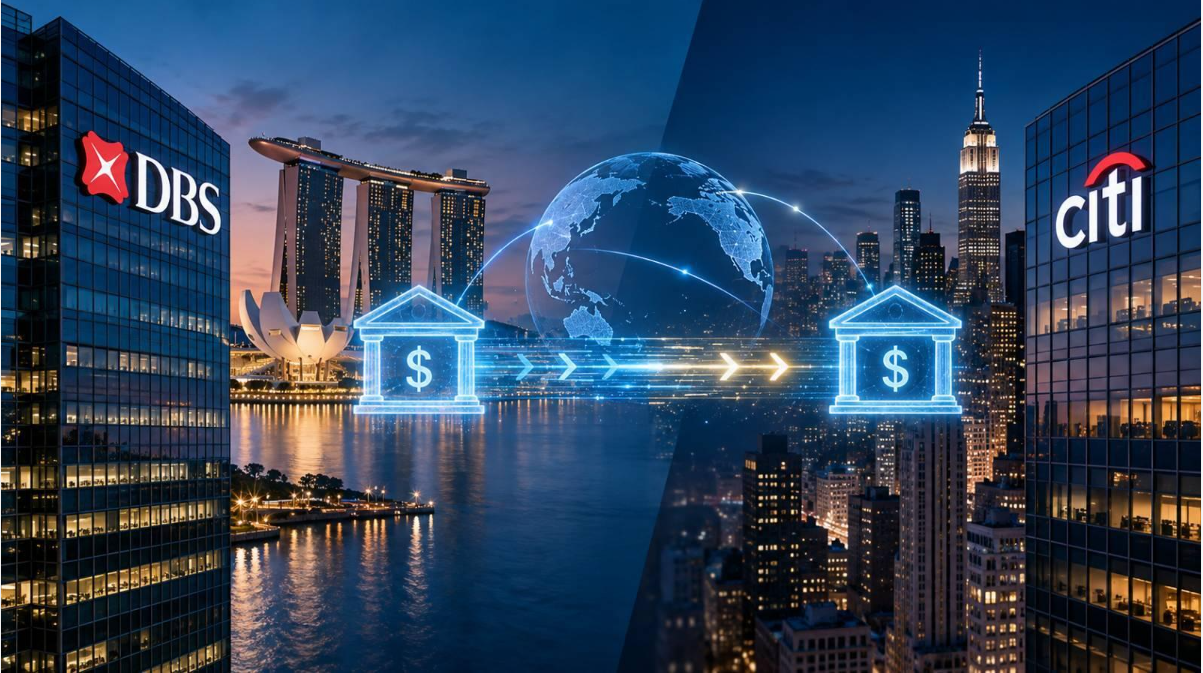 For years, blockchain has mainly been associated with Bitcoin, Ethereum and other cryptocurrencies. But some of the biggest developments in the technology are now happening inside traditional banking.
On 16 November 2026, Singapore’s DBS Bank and JPMorgan Chase announced a new connection between their blockchain-based banking networks. The system allows eligible institutional clients to move US dollars between accounts in Singapore and the United States, including outside normal banking hours and over weekends.
The development is significant because it shows how banks are beginning to use blockchain technology to improve the movement of money without necessarily involving cryptocurrencies.
What exactly have the banks introduced?
The arrangement connects DBS Token Services with Kinexys by J.P. Morgan, two systems that allow participating institutions to move digital representations of bank deposits.
These are known as tokenised deposits.
In simple terms, a tokenised deposit represents money held in a traditional bank account, but it is recorded and transferred using blockchain technology.
For example, a company operating in Singapore and the United States may need to move dollars between its business operations in the two countries. Through the connected networks, eligible clients can move funds without waiting for the usual banking hours.
DBS and JPMorgan say transfers within the connected blockchain networks can take place 24 hours a day, seven days a week.
Ant International is the first client announced to use the solution for real-time global treasury management.
Why does this matter for international businesses?
Traditional international bank transfers can involve different banks, time zones, payment cut-off times and settlement processes.
A payment initiated late on Friday may not be processed fully until the next working day. For businesses operating across several countries, these delays can affect supplier payments, cash flow and access to working capital.
The new arrangement is designed to reduce some of these delays by allowing participating institutions to move tokenised dollar deposits across connected networks.
This could be particularly useful for:
- Companies managing money across several countries.
- Importers and exporters making international payments.
- E-commerce businesses receiving and paying suppliers in different markets.
- Financial institutions managing liquidity across different time zones.
- Businesses that need access to funds outside ordinary banking hours.
However, the service is currently designed for eligible institutional clients, not ordinary individuals sending money through a retail banking app.
Is this the same as using Bitcoin or USDT?
No. This is an important distinction.
Bitcoin and USDT are digital assets that operate on their respective blockchain networks. Tokenised deposits, on the other hand, represent money held within a commercial bank.
The difference is in who issues and manages the money.
With Bitcoin, transactions take place on a decentralised network. With USDT, the stablecoin is issued by Tether. With tokenised deposits, the underlying funds remain bank deposits, with the bank providing the banking relationship and infrastructure.
The banks are using blockchain as a way to move and record value more efficiently, rather than asking customers to convert their money into cryptocurrency.
This is one reason traditional financial institutions are paying closer attention to blockchain technology. They can explore its speed and programmability while continuing to work within established banking structures.
What about the risks and limitations?
Although the announcement is an important development, it does not mean every international bank transfer will now be instant.
The system connects specific banking networks and is available to eligible institutional clients. It is not a universal payment service.
There are also limitations around moving funds between traditional bank accounts and the blockchain-based deposit accounts. According to the banks’ published information, transfers within the Kinexys network operate around the clock, but moving funds between traditional accounts and blockchain deposit accounts still has a three-hour weekend maintenance window.
That means the entire banking process is not yet completely free of downtime.
Wider adoption will also depend on regulatory requirements, interoperability between different banking systems and the willingness of more financial institutions to participate.
Could this change international payments in Africa?
Africa has a strong interest in faster and more accessible cross-border payments. Businesses regularly need to pay suppliers, receive money from international customers and manage funds across different currencies.
For an importer in Uganda purchasing goods from China, for example, the cost and timing of an international payment can affect the final cost of doing business.
A faster settlement system could help businesses manage their money more efficiently, particularly when they operate across several markets.
However, the DBS and JPMorgan arrangement does not currently provide a direct payment service for Ugandan businesses. Its initial connection is between participating banking networks in Singapore and the United States.
The wider significance for Africa is that global financial institutions are actively developing new ways to move money across borders. Similar infrastructure could eventually influence how banks and payment providers in other regions handle international transactions.
The bigger picture: Banks are not ignoring blockchain anymore
The latest announcement is part of a wider shift in the financial industry.
Banks are no longer looking at blockchain only as the technology behind cryptocurrencies. They are exploring how it can support deposits, international payments, treasury management and the settlement of financial assets.
For the cryptocurrency industry, this development is worth watching. Traditional banks adopting blockchain does not mean they are adopting Bitcoin or USDT, but it does show that the technology behind digital assets is becoming increasingly relevant to mainstream finance.
The next major development may not simply be more people buying cryptocurrency. It could be a financial system where banks, payment companies and digital asset platforms increasingly use blockchain-based infrastructure to move money.
And as more institutions connect their systems, the way businesses send and receive money internationally could look very different in the years ahead.
Still have questions?
Message us on WhatsApp — we reply instantly and can walk you through your exchange step by step.
Chat on WhatsApp