The $482 Billion Stablecoin Payment Shift
Why Digital Dollars Are Becoming More Than Trading Assets
Subtitle: New 2026 payment data reveals a growing gap between stablecoin supply and actual usage, raising important questions about the future of digital dollar transactions in Africa.
For years, stablecoins have largely been discussed in connection with cryptocurrency trading. Investors use them to move between digital assets, traders hold them when they want exposure to the US dollar, and cryptocurrency exchanges rely on them to facilitate transactions.
But a new set of figures from 2026 suggests that another part of the stablecoin market deserves closer attention: payments.
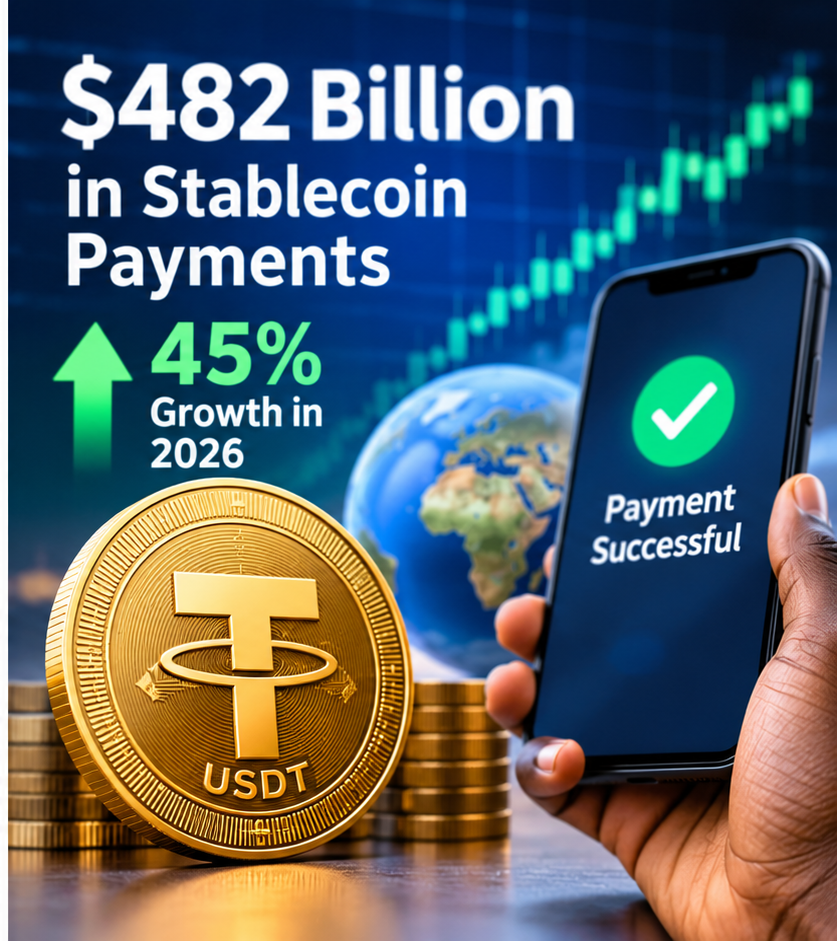
According to blockchain analytics firm Allium’s Q3 2026 report, stablecoin payment activity reached approximately $482 billion during the first nine months of the year, representing a 45% increase compared with the corresponding period a year earlier.
What makes the development particularly interesting is that stablecoin supply barely increased during the same period.
The total supply grew by just 0.4% to approximately $305 billion, while payment activity expanded considerably.
This suggests that existing stablecoins are circulating more frequently, even without a comparable increase in the total amount of digital dollars in existence.
For Africa, where international payments, foreign currency access and remittance costs remain important financial concerns, this development deserves attention.
Stablecoin Payments Are Growing Faster Than Supply
The difference between stablecoin supply and payment activity provides an important insight into how the market is changing.
Stablecoin supply measures the value of tokens in circulation. Payment activity, on the other hand, measures qualifying payment transactions identified by the data provider.
When payment activity grows faster than supply, it can indicate that existing tokens are being used more frequently rather than simply being held in wallets.
Allium’s Q3 2026 report also recorded a 71% increase in payment transaction count, reaching approximately 1.04 billion transactions.
The figures suggest that stablecoins are gradually developing a more active role in digital payment systems.
However, it is important not to confuse every blockchain transfer with a real-world payment. Transfers between exchange wallets, internal movements and other blockchain activities are not necessarily payments made by customers to businesses.
The distinction matters because the usefulness of stablecoins as a payment method should be measured by actual economic activity, not simply by large transaction numbers.
Why Digital Dollars Are Becoming Important in International Payments
International money transfers remain an important challenge for individuals and businesses operating across borders.
Traditional payment systems can involve several intermediaries, currency conversion charges and settlement procedures. Depending on the countries involved, receiving funds may also require access to particular banking arrangements.
Stablecoins offer another possible approach.
A dollar-linked stablecoin can be transferred between compatible blockchain wallets without requiring the same traditional correspondent banking process for every movement.
For businesses, this creates potential applications in:
- Paying international suppliers.
- Receiving payments from overseas clients.
- Managing digital dollar balances.
- Moving value between participating markets.
- Facilitating payments through supported financial service providers.
The practical benefits depend on the available infrastructure, local currency conversion, liquidity and regulatory requirements.
Stablecoins are therefore not a universal replacement for banks or established remittance providers. Their importance lies in creating additional options for moving and settling value.
Why This Development Matters to African Markets
Africa has a particular interest in the evolution of stablecoin payments.
Businesses in the region regularly interact with international suppliers, customers and financial partners. Access to foreign currency and efficient payment channels can influence how easily these businesses operate.
According to the OECD’s Africa Capital Markets Report 2026, Sub-Saharan Africa recorded a 52% year-on-year increase in the total value of crypto-assets transacted in 2025.
The report identifies several factors behind crypto-asset adoption, including currency volatility, limited access to traditional financial services and the costs associated with conventional international payment arrangements.
Stablecoins are part of this wider development.
For individuals receiving money from abroad, dollar-linked digital assets may provide an alternative means of holding and transferring value where supported and legally permitted.
For businesses, they may offer additional settlement options when dealing with international customers and suppliers.
Nevertheless, the ability to receive a stablecoin is only one part of the process. Converting it into usable local currency remains an equally important consideration.
The Conversion Challenge: Receiving Digital Dollars Is Not the Whole Story
One of the less discussed aspects of stablecoin adoption is what happens after a person receives the funds.
A freelancer may receive payment in USDT from an international client but still need Ugandan shillings to pay rent, purchase supplies or meet everyday expenses.
An importer may receive digital dollars but require a practical way to convert them into the currency needed for business operations.
This creates demand for exchange services that can connect digital assets with conventional currencies.
The conversion process involves several considerations:
Exchange rates: Customers need to understand the rate being offered and how it compares with the prevailing market rate.
Network selection: Stablecoins can exist on different blockchain networks. Sending funds through an unsupported network can result in lost funds or complicated recovery procedures.
Liquidity: An exchange provider needs access to sufficient liquidity to facilitate the requested conversion.
Transaction charges: Network fees and service charges should be understood before a transaction is initiated.
Verification and compliance: Customers should work with providers that follow applicable identification, transaction monitoring and financial compliance requirements.
These considerations are particularly important as stablecoin payments become more visible in everyday financial discussions.
Uganda’s Position in the Growing Digital Dollar Economy
Uganda is part of the wider African market experiencing growing interest in digital assets.
USDT and other dollar-linked stablecoins are relevant to conversations about international payments, digital asset trading and foreign currency access.
However, the local market must be understood within its own financial and regulatory environment.
Not every international stablecoin payment service is available in Uganda, and not every platform that operates elsewhere is authorised to provide services locally.
Customers should therefore distinguish between the ability to transfer a digital asset on a blockchain and the ability to exchange that asset through a compliant local service provider.
For Ugandan businesses, the practical questions remain straightforward:
How can international payments be received? What conversion options are available? What costs apply? How quickly can the recipient access the funds?
These questions are likely to become increasingly important as traditional financial institutions and digital asset businesses explore ways to connect their services.
Stablecoins Still Face Important Challenges
Despite the growth in payment activity, stablecoins are not without risks.
Their value depends on the quality of their reserves, the reliability of their issuers and the mechanisms used to maintain their intended peg.
A stablecoin designed to track the US dollar does not carry the same guarantees as a deposit held in a regulated commercial bank.
There are also risks associated with cybercrime, wallet security, blockchain network failures, liquidity shortages and regulatory changes.
Another important issue is the difference between transaction volume and genuine payment activity.
CoinDesk’s November 2026 reporting on Allium’s figures highlighted that payment activity represents only a small proportion of the much larger raw stablecoin transfer value recorded on blockchain networks.
This is an important reminder that growing blockchain activity should not automatically be interpreted as widespread adoption for everyday purchases.
The market is developing, but its long-term success will depend on whether stablecoins can deliver reliable services that meet real customer needs.
What Comes Next for Cryptocurrency Exchange Businesses?
The expansion of stablecoin payments creates opportunities for businesses involved in digital asset exchange and financial services.
As more individuals and organisations become familiar with digital dollars, the demand for services that help them buy, sell and convert these assets may also develop.
Exchange businesses will need to compete on more than simply offering access to cryptocurrency.
Customers increasingly need clear exchange rates, transparent fees, dependable transaction processes, proper verification and accessible customer support.
For service providers operating in African markets, the ability to understand both digital asset transactions and local currency requirements could become an important competitive advantage.
The future of stablecoins may therefore be shaped not only by the companies issuing the tokens, but also by the businesses building practical connections between digital currencies and the conventional financial system.
The Bigger Picture: Digital Dollars Are Finding a Wider Purpose
The $482 billion payment figure does not mean that stablecoins have replaced traditional payment systems. Nor does it mean that every cryptocurrency user is now using digital assets to pay for goods and services.
What it demonstrates is that stablecoin payment activity is expanding, even as the overall supply of these digital assets remains relatively unchanged.
That is an important development for a market that has traditionally been associated with cryptocurrency trading.
For Africa, the next question is how this growing infrastructure can be connected to the financial needs of individuals and businesses.
International payments, remittances, supplier settlements and currency conversion are all areas where more efficient financial infrastructure could make a difference.
As the digital asset market matures, the ability to convert between cryptocurrency and conventional currency will remain an important part of the customer experience.
BuyCrypto Africa provides cryptocurrency and currency exchange services for customers seeking practical exchange solutions. Whether you are looking to buy or sell digital assets or enquire about currency exchange, contact our team to discuss your transaction requirements and the available options.
Disclaimer: This article is provided for general informational and educational purposes only and does not constitute financial, investment or legal advice. Stablecoins are not risk-free and may be affected by issuer, reserve, liquidity, cybersecurity, market and regulatory risks. Payment figures are based on the reporting methodology of the cited data provider and should not be interpreted as representing all stablecoin transfers or retail payments. Always verify transaction details, service availability and applicable regulatory requirements before proceeding.
Still have questions?
Message us on WhatsApp — we reply instantly and can walk you through your exchange step by step.
Chat on WhatsApp