How to Store Bitcoin, USDT and Other Digital Assets Safely
Introduction
Cryptocurrency has created new ways for people to transfer money, make payments and hold digital assets. Bitcoin, USDT, Ethereum and other cryptocurrencies can be sent across blockchain networks without relying on the traditional payment systems used for every transaction.
However, owning cryptocurrency also introduces an important responsibility: understanding how digital assets are stored and controlled.
Unlike cash kept in a physical wallet, cryptocurrency is recorded on a blockchain. Access to those assets depends on cryptographic keys and the wallet software or device used to manage them. Understanding this system helps users make informed decisions about security, convenience and long-term storage.
For Ugandans exploring digital assets, whether for personal use, online work or business transactions, learning how crypto wallets work is an important first step.
A wallet can be convenient and easy to use, but not every wallet offers the same level of control or protection. Some are designed for frequent transactions, while others prioritise long-term storage. Choosing between them depends on how the assets will be used, the amount involved and the user’s ability to manage security responsibilities.
This guide explains cryptocurrency wallets in practical terms, including wallet types, private keys, recovery phrases, common mistakes and the steps users can take to protect their digital assets.
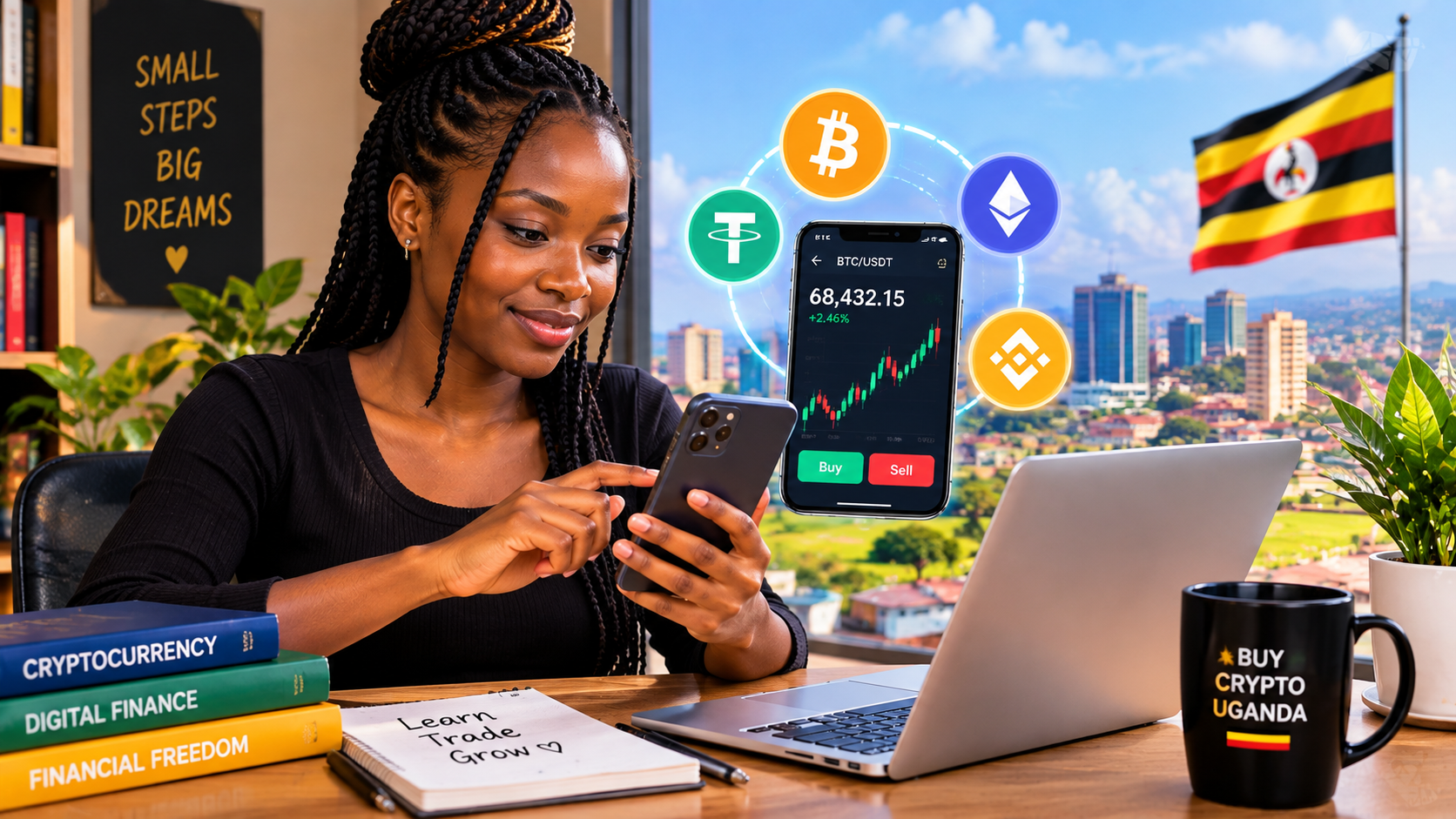
What Is a Cryptocurrency Wallet?
A cryptocurrency wallet is a tool that allows a person to interact with a blockchain and manage cryptocurrency associated with their addresses.
It can take the form of a mobile application, desktop program, browser extension, hardware device or account provided by a cryptocurrency exchange.
Despite the name, a crypto wallet does not usually store digital coins inside the device in the same way a physical wallet holds banknotes. Cryptocurrency transactions are recorded on a blockchain, which is a distributed ledger maintained by a network of computers.
The wallet manages the information needed to access and authorise transactions involving the assets associated with particular blockchain addresses.
For example, someone holding USDT may use a wallet to view their balance, receive tokens, send tokens to another address and review previous transactions.
The wallet helps the user interact with the blockchain, but the exact level of control depends on whether the user controls the private keys.
This distinction is important because a wallet managed directly by its owner operates differently from an exchange account where a service provider controls the keys on the user’s behalf.
How Does a Crypto Wallet Work?
A typical cryptocurrency wallet works through three main elements: an address, a private key and a blockchain network.
The wallet address: This is the destination used when receiving cryptocurrency. It can be shared with someone who needs to send funds to the wallet.
The private key: This is a cryptographic secret that authorises certain transactions. Anyone who obtains control of the relevant private key may be able to move the associated assets.
The blockchain: This is the network ledger where transactions are recorded and verified according to the network’s rules.
Suppose a freelancer in Uganda receives USDT from an international client. The freelancer provides a receiving address compatible with the token and network being used. The client sends the funds, and the blockchain processes the transaction.
Once the transaction reaches the necessary confirmation stage, the wallet can display the incoming balance.
The wallet does not need to hold physical money or receive banknotes. It provides the tools for interacting with the digital asset recorded on the blockchain.
The Main Types of Cryptocurrency Wallets
Crypto wallets differ in how they operate, how keys are managed and how easily users can access their funds.
The most common distinction is between hot wallets and cold wallets. Custodial and non-custodial wallets are another important distinction.
Understanding both classifications makes it easier to choose an appropriate storage method.
1. Hot Wallets
A hot wallet is a cryptocurrency wallet that is connected to the internet or regularly operates through an internet-connected environment.
Examples include mobile wallet applications, browser extensions and desktop wallets used online.
Hot wallets are popular because they make it easy to access cryptocurrency and complete transactions without needing a separate physical device.
They can be useful for people who regularly send or receive digital assets, pay for online services or move funds between wallets.
For instance, a person who receives small amounts of cryptocurrency for freelance work may prefer a mobile wallet because it allows them to check incoming transactions and make payments while away from a computer.
However, internet connectivity also creates security considerations. A compromised phone, malicious application, phishing website or exposed recovery phrase can put the assets at risk.
Users should download wallet applications from verified sources, protect their devices with strong security settings and avoid entering recovery phrases into unfamiliar websites.
A hot wallet can be convenient, but convenience should not replace careful security practices.
2. Cold Wallets
A cold wallet is a storage arrangement designed to keep private keys offline during normal use.
Hardware wallets are a common example. These devices can store private keys in a protected environment and allow users to approve transactions without exposing the keys directly to an internet-connected computer.
Cold storage is often considered for people holding cryptocurrency over longer periods or managing balances that they do not need to access frequently.
For example, a user who intends to hold Bitcoin for several years may choose a hardware wallet instead of keeping all their assets in a wallet used every day.
Cold storage reduces some online risks, but it does not eliminate every possible threat. Users can still lose access through poor backup practices, device damage, theft, malicious transaction approvals or disclosure of their recovery phrase.
A hardware wallet is only as secure as the way it is configured and used.
People considering this option should obtain devices from trustworthy sources, follow the manufacturer’s security instructions and verify transaction details on the device itself where supported.
3. Custodial Wallets
A custodial wallet is managed by a third party that controls the private keys.
Many cryptocurrency exchanges use custodial arrangements. Users sign in to their accounts to view balances and request withdrawals, while the platform manages the underlying wallet infrastructure.
This can simplify the experience for beginners because they may not need to manage blockchain keys or recovery phrases directly.
However, custodial services introduce dependence on the provider. Account restrictions, platform outages, withdrawal delays, security incidents or insolvency can affect access to funds.
The user should understand the provider’s terms, withdrawal procedures, identity-verification requirements and security practices before depositing cryptocurrency.
An account balance shown on an exchange is not necessarily the same as personally controlling cryptocurrency through a private key.
4. Non-Custodial Wallets
A non-custodial wallet allows the user to control the private keys or recovery mechanism needed to manage the assets.
This provides greater direct control, but it also transfers more responsibility to the user.
If the user loses the recovery information and has no usable backup, the assets may become permanently inaccessible. A wallet provider generally cannot reset a blockchain private key in the same way a bank can reset an online banking password.
Non-custodial wallets therefore require careful backup and security planning.
The choice between custodial and non-custodial storage depends on the user’s technical knowledge, preferences, transaction habits and tolerance for managing their own security.
What Is the Difference Between a Public Address and a Private Key?
One of the most important wallet-security lessons is learning which information can be shared and which information must remain secret.
A public wallet address allows other people to send cryptocurrency to the wallet. Depending on the blockchain, transactions and balances associated with the address may be publicly visible.
A private key, by contrast, is a secret used to authorise transactions. It should never be shared with someone who does not need legitimate control over the assets.
Think of the public address as a destination for receiving funds and the private key as a critical authorisation credential.
For example, if a business wants to receive a cryptocurrency payment from a customer, it can provide the appropriate receiving address. It should not provide its private key or recovery phrase.
A legitimate sender does not need the recipient’s recovery phrase to make a payment.
Anyone who asks for a private key or recovery phrase to release a payment, verify a wallet or unlock a supposed reward should be treated with extreme caution.
Understanding Recovery Phrases
Many non-custodial wallets generate a recovery phrase, sometimes called a seed phrase.
This phrase usually consists of a sequence of words that can restore access to the wallet, depending on the wallet’s design and supported standards.
It is extremely sensitive information. Someone who obtains the recovery phrase may be able to recreate the wallet and transfer its assets.
Users should write down the recovery phrase according to the wallet provider’s instructions and keep it somewhere private and secure.
Avoid storing an unprotected photograph of the phrase on a phone, sharing it through messaging applications or uploading it to cloud storage without understanding the security implications.
A recovery phrase should not be entered into a website merely because a message claims that an account needs urgent verification.
It is also important to check that the backup has been recorded correctly. A missing or incorrect word may prevent successful recovery.
For significant holdings, users should consider how they would recover access after losing a phone, damaging a computer or experiencing another emergency.
A backup should protect against accidental loss without making the recovery information easy for an unauthorised person to find.
How to Choose a Wallet for Bitcoin and USDT
The right wallet depends on the cryptocurrency, the network and the way the assets will be used.
Bitcoin and USDT are not interchangeable in terms of wallet compatibility. Bitcoin uses its own blockchain, while USDT exists on several networks.
A wallet that supports Bitcoin does not automatically support every version of USDT. Similarly, a wallet that supports USDT on one network may not support the same token on another.
Before choosing a wallet, consider the following factors.
Supported assets: Confirm that the wallet supports the specific cryptocurrency you want to receive or hold.
Network compatibility: For USDT, verify the exact network supported by both the sending and receiving sides.
Key control: Establish whether you control the private keys or rely on a third-party provider.
Security features: Look for appropriate device protection, transaction approvals, backup options and a clear security history.
Ease of use: A wallet should be understandable enough that you can check addresses and approve transactions carefully.
Recovery arrangements: Know how to restore access if your phone, computer or hardware device is lost or damaged.
Costs: Consider purchase costs for hardware wallets and any network fees charged when transferring cryptocurrency.
No single wallet is the best choice for every user. Someone who makes frequent small transactions may value accessibility, while someone holding assets for several years may prioritise offline key storage.
How to Receive Cryptocurrency Safely
Receiving cryptocurrency requires more than copying an address and waiting for a balance to appear.
Start by confirming the asset you are receiving and the network the sender intends to use.
If you are receiving USDT, for example, confirm whether the transfer will use TRON, Ethereum or another supported network. Do not assume that all USDT addresses are interchangeable.
Next, copy the receiving address directly from the intended wallet and check it carefully. Malware can sometimes replace copied addresses with an attacker’s address.
For a larger transfer, a small test transaction may be appropriate if the additional network fee is reasonable and the recipient can confirm receipt.
Share only the information needed to receive the payment. Never disclose private keys, recovery phrases or passwords.
After the sender initiates the transfer, request the transaction ID if you need to verify its progress. Check the transaction through an appropriate blockchain explorer or the receiving service’s official interface.
Remember that an address can be valid in format without belonging to the intended recipient. Checking the address and network remains essential.
How to Send Cryptocurrency Without Making Costly Mistakes
Sending cryptocurrency usually involves choosing an asset, entering a recipient address, selecting the relevant network where applicable and approving the transaction.
Because many blockchain transactions cannot simply be cancelled after confirmation, users should take time to verify the details before approving a transfer.
Check the following:
Confirm the recipient’s wallet address.
Confirm the cryptocurrency and blockchain network.
Review the amount being sent.
Check the estimated network fee and any additional service charges.
Confirm the final amount that will leave the wallet.
Review the transaction details before signing or approving it.
A transfer can fail to reach its intended destination if the wrong network is selected or the receiving platform does not support the deposit method.
In some situations, recovery may be technically difficult, costly or impossible.
For business payments, use a documented approval process. If more than one person manages the company’s assets, consider requiring independent verification for large transfers.
These steps help reduce avoidable errors and make transaction records easier to reconcile.
Common Cryptocurrency Wallet Mistakes
Wallet-related losses can occur even when users understand the basics of cryptocurrency.
One common mistake is sharing recovery information with someone pretending to be customer support. Legitimate support staff should not need a user’s recovery phrase to investigate an ordinary transaction.
Another is downloading a counterfeit wallet application that imitates a legitimate product. Users should verify the application publisher and official website before installation.
Keeping all assets in an account with a weak password or no additional authentication also creates unnecessary risk.
Some users fail to create a recovery backup, only to discover that they cannot access their assets after losing a device.
Others approve wallet transactions without understanding the permissions involved. Some applications and smart contracts request permissions that may allow them to interact with tokens beyond a single immediate transaction.
Users should review requested permissions, avoid unfamiliar links and periodically review and revoke unnecessary token approvals where the relevant blockchain and wallet support this feature.
Finally, people sometimes assume that every transaction can be reversed by contacting a wallet provider. Blockchain transactions generally do not work like card payments, and a mistaken transfer may not be recoverable.
Prevention is therefore especially important.
What Should Ugandan Businesses Know About Crypto Wallets?
Businesses that receive or pay cryptocurrency should treat wallet management as part of their financial controls.
A company receiving digital assets from international clients should identify who is authorised to access its wallets, how transaction details are recorded and how funds are reconciled with invoices.
It should also distinguish between money received into a business-controlled wallet and balances held with an external service provider.
For larger organisations, a documented wallet policy can specify transaction limits, approval requirements, backup responsibilities and procedures for staff changes.
Businesses should also consider how they will value cryptocurrency holdings for accounting purposes and meet their applicable legal, tax and reporting obligations.
If a company accepts USDT as payment, it should record the amount received, the relevant network, the transaction ID, the date and the agreed valuation method.
These records can help explain the source and destination of funds and resolve accounting questions.
Security responsibilities become more important when several employees or contractors participate in handling digital assets.
Frequently Asked Questions
Can I use one wallet for Bitcoin and USDT?
Some wallets support both assets, but compatibility varies. Bitcoin and USDT may use different blockchain networks, so users must confirm support for each specific asset and network.
Is a mobile wallet safe?
A reputable mobile wallet can be useful, especially when combined with strong device security, careful application selection and a secure recovery backup. However, no wallet is completely risk-free.
Can I recover my cryptocurrency if I lose my phone?
Possibly. If you have the correct recovery phrase or another supported recovery method, you may be able to restore a non-custodial wallet. A custodial account may have a different account-recovery process. Without the required recovery information, access may be permanently lost.
Should I keep all my cryptocurrency on an exchange?
That depends on your circumstances and the provider’s arrangements. Exchange accounts can be convenient, but they introduce dependence on the service. Self-custody offers more direct control but requires you to manage keys and backups responsibly.
Does a wallet protect me from cryptocurrency price changes?
No. A wallet manages access to digital assets; it does not prevent their market value from changing. Even stablecoins such as USDT carry issuer, operational and other risks, and their value is not guaranteed in every situation.
Do I need to pay to create a cryptocurrency wallet?
Many software wallets are free to download, although transactions may incur blockchain network fees. Hardware wallets usually require an upfront purchase, and some services may charge additional fees.
Conclusion
Understanding cryptocurrency wallets is an important part of using digital assets responsibly. A wallet is more than an application displaying a balance: it is a tool for managing access to assets recorded on a blockchain.
The main decision is not simply which wallet looks easiest to use. It is whether the wallet supports the required assets and networks, how its keys are controlled, how access can be recovered and what security responsibilities the user must manage.
For Ugandan individuals, freelancers and businesses, good wallet practices can help reduce avoidable mistakes when receiving, holding and sending cryptocurrency.
Always verify receiving addresses, keep recovery information private, understand network compatibility and review transactions before approving them.
Cryptocurrency offers useful digital payment possibilities, but responsible use begins with understanding how access and security actually work.
About BuyCrypto Uganda
BuyCrypto Uganda provides information and services relating to digital assets and cryptocurrency transactions. Readers can visit the website to explore supported cryptocurrencies, exchange information and available services. Always confirm current transaction terms, supported networks and applicable requirements before proceeding with a transfer.
Still have questions?
Message us on WhatsApp — we reply instantly and can walk you through your exchange step by step.
Chat on WhatsApp